pypots.nn
pypots.nn.functional
- pypots.nn.functional.gather_listed_dicts(dict_list)[source]
Gather batched dict output from model forward
- Parameters:
dict_list (
list) – A list of dict output from model forward. Each dict should have the same keys.- Returns:
A dict with the same keys as the input dict, but with values concatenated along the batch dimension.
- Return type:
gathered_dict
- pypots.nn.functional.nonstationary_norm(X, missing_mask=None)[source]
Normalization from Non-stationary Transformer. Please refer to [30] for more details.
- Parameters:
X (torch.Tensor) – Input data to be normalized. Shape: (n_samples, n_steps (seq_len), n_features).
missing_mask (torch.Tensor, optional) – Missing mask has the same shape as X. 1 indicates observed and 0 indicates missing.
- Return type:
- Returns:
X_enc (torch.Tensor) – Normalized data. Shape: (n_samples, n_steps (seq_len), n_features).
means (torch.Tensor) – Means values for de-normalization. Shape: (n_samples, n_features) or (n_samples, 1, n_features).
stdev (torch.Tensor) – Standard deviation values for de-normalization. Shape: (n_samples, n_features) or (n_samples, 1, n_features).
- pypots.nn.functional.nonstationary_denorm(X, means, stdev)[source]
De-Normalization from Non-stationary Transformer. Please refer to [30] for more details.
- Parameters:
X (torch.Tensor) – Input data to be de-normalized. Shape: (n_samples, n_steps (seq_len), n_features).
means (torch.Tensor) – Means values for de-normalization . Shape: (n_samples, n_features) or (n_samples, 1, n_features).
stdev (torch.Tensor) – Standard deviation values for de-normalization. Shape: (n_samples, n_features) or (n_samples, 1, n_features).
- Returns:
X_denorm – De-normalized data. Shape: (n_samples, n_steps (seq_len), n_features).
- Return type:
- pypots.nn.functional.calc_mae(predictions, targets, masks=None)[source]
Calculate the Mean Absolute Error between
predictionsandtargets.maskscan be used for filtering. For values==0 inmasks, values at their corresponding positions inpredictionswill be ignored.- Parameters:
predictions (
Union[ndarray,Tensor]) – The prediction data to be evaluated.targets (
Union[ndarray,Tensor]) – The target data for helping evaluate the predictions.masks (
Union[ndarray,Tensor,None]) – The masks for filtering the specific values in inputs and target from evaluation. When given, only values at corresponding positions where values ==1 inmaskswill be used for evaluation.
- Return type:
Examples
>>> import numpy as np
>>> from pypots.nn.functional import calc_mae
>>> targets = np.array([1, 2, 3, 4, 5])
>>> predictions = np.array([1, 2, 1, 4, 6])
>>> mae = calc_mae(predictions, targets)
mae = 0.6 here, the error is from the 3rd and 5th elements and is
 , so the result is 3/5=0.6.
If we want to prevent some values from MAE calculation, e.g. the first three elements here, we can use
masksto filter out them:>>> masks = np.array([0, 0, 0, 1, 1]) >>> mae = calc_mae(predictions, targets, masks)
mae = 0.5 here, the first three elements are ignored, the error is from the 5th element and is
 ,
so the result is 1/2=0.5.
,
so the result is 1/2=0.5.
- pypots.nn.functional.calc_mse(predictions, targets, masks=None)[source]
Calculate the Mean Square Error between
predictionsandtargets.maskscan be used for filtering. For values==0 inmasks, values at their corresponding positions inpredictionswill be ignored.- Parameters:
predictions (
Union[ndarray,Tensor]) – The prediction data to be evaluated.targets (
Union[ndarray,Tensor]) – The target data for helping evaluate the predictions.masks (
Union[ndarray,Tensor,None]) – The masks for filtering the specific values in inputs and target from evaluation. When given, only values at corresponding positions where values ==1 inmaskswill be used for evaluation.
- Return type:
Examples
>>> import numpy as np
>>> from pypots.nn.functional import calc_mse
>>> targets = np.array([1, 2, 3, 4, 5])
>>> predictions = np.array([1, 2, 1, 4, 6])
>>> mse = calc_mse(predictions, targets)
mse = 1 here, the error is from the 3rd and 5th elements and is
 , so the result is 5/5=1.
If we want to prevent some values from MSE calculation, e.g. the first three elements here, we can use
masksto filter out them:>>> masks = np.array([0, 0, 0, 1, 1]) >>> mse = calc_mse(predictions, targets, masks)
mse = 0.5 here, the first three elements are ignored, the error is from the 5th element and is
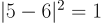 ,
so the result is 1/2=0.5.
,
so the result is 1/2=0.5.
- pypots.nn.functional.calc_rmse(predictions, targets, masks=None)[source]
Calculate the Root Mean Square Error between
predictionsandtargets.maskscan be used for filtering. For values==0 inmasks, values at their corresponding positions inpredictionswill be ignored.- Parameters:
predictions (
Union[ndarray,Tensor]) – The prediction data to be evaluated.targets (
Union[ndarray,Tensor]) – The target data for helping evaluate the predictions.masks (
Union[ndarray,Tensor,None]) – The masks for filtering the specific values in inputs and target from evaluation. When given, only values at corresponding positions where values ==1 inmaskswill be used for evaluation.
- Return type:
Examples
>>> import numpy as np
>>> from pypots.nn.functional import calc_rmse
>>> targets = np.array([1, 2, 3, 4, 5])
>>> predictions = np.array([1, 2, 1, 4, 6])
>>> rmse = calc_rmse(predictions, targets)
rmse = 1 here, the error is from the 3rd and 5th elements and is
,
so the result is  .
.If we want to prevent some values from RMSE calculation, e.g. the first three elements here, we can use
masksto filter out them:>>> masks = np.array([0, 0, 0, 1, 1]) >>> rmse = calc_rmse(predictions, targets, masks)
rmse = 0.707 here, the first three elements are ignored, the error is from the 5th element and is
,
so the result is 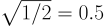 .
.
- pypots.nn.functional.calc_mre(predictions, targets, masks=None)[source]
Calculate the Mean Relative Error between
predictionsandtargets.maskscan be used for filtering. For values==0 inmasks, values at their corresponding positions inpredictionswill be ignored.- Parameters:
predictions (
Union[ndarray,Tensor]) – The prediction data to be evaluated.targets (
Union[ndarray,Tensor]) – The target data for helping evaluate the predictions.masks (
Union[ndarray,Tensor,None]) – The masks for filtering the specific values in inputs and target from evaluation. When given, only values at corresponding positions where values ==1 inmaskswill be used for evaluation.
- Return type:
Examples
>>> import numpy as np
>>> from pypots.nn.functional import calc_mre
>>> targets = np.array([1, 2, 3, 4, 5])
>>> predictions = np.array([1, 2, 1, 4, 6])
>>> mre = calc_mre(predictions, targets)
mre = 0.2 here, the error is from the 3rd and 5th elements and is
,
so the result is  .
.If we want to prevent some values from MRE calculation, e.g. the first three elements here, we can use
masksto filter out them:>>> masks = np.array([0, 0, 0, 1, 1]) >>> mre = calc_mre(predictions, targets, masks)
mre = 0.111 here, the first three elements are ignored, the error is from the 5th element and is
,
so the result is .
- pypots.nn.functional.calc_quantile_crps(predictions, targets, masks, scaler_mean=0, scaler_stddev=1)[source]
Continuous rank probability score for distributional predictions.
- Parameters:
predictions (
Union[ndarray,Tensor]) – The prediction data to be evaluated.targets (
Union[ndarray,Tensor]) – The target data for helping evaluate the predictions.masks (
Union[ndarray,Tensor]) – The masks for filtering the specific values in inputs and target from evaluation. Only values at corresponding positions where values ==1 inmaskswill be used for evaluation.scaler_mean – Mean value of the scaler used to scale the data.
scaler_stddev – Standard deviation value of the scaler used to scale the data.
- Returns:
Value of continuous rank probability score.
- Return type:
CRPS
- pypots.nn.functional.calc_quantile_crps_sum(predictions, targets, masks, scaler_mean=0, scaler_stddev=1)[source]
Sum continuous rank probability score for distributional predictions.
- Parameters:
predictions (
Union[ndarray,Tensor]) – The prediction data to be evaluated.targets (
Union[ndarray,Tensor]) – The target data for helping evaluate the predictions.masks (
Union[ndarray,Tensor]) – The masks for filtering the specific values in inputs and target from evaluation. Only values at corresponding positions where values ==1 inmaskswill be used for evaluation.scaler_mean – Mean value of the scaler used to scale the data.
scaler_stddev – Standard deviation value of the scaler used to scale the data.
- Returns:
Sum value of continuous rank probability score.
- Return type:
CRPS
- pypots.nn.functional.calc_binary_classification_metrics(prob_predictions, targets, pos_label=1)[source]
Calculate the evaluation metrics for the binary classification task, including accuracy, precision, recall, f1 score, area under ROC curve, and area under Precision-Recall curve. If targets contains multiple categories, please set the positive category as pos_label.
- Parameters:
prob_predictions (
ndarray) – Estimated probability predictions returned by a decision function.targets (
ndarray) – Ground truth (correct) classification results.pos_label (
int) – The label of the positive class. Note that pos_label is also the index used to extract binary prediction probabilities from predictions.
- Returns:
A dictionary contains classification metrics and useful results:
predictions: binary categories of the prediction results;
accuracy: prediction accuracy;
precision: prediction precision;
recall: prediction recall;
f1: F1-score;
precisions: precision values of Precision-Recall curve
recalls: recall values of Precision-Recall curve
pr_auc: area under Precision-Recall curve
fprs: false positive rates of ROC curve
tprs: true positive rates of ROC curve
roc_auc: area under ROC curve
- Return type:
classification_metrics
- pypots.nn.functional.calc_precision_recall_f1(prob_predictions, targets, pos_label=1)[source]
Calculate precision, recall, and F1-score of model predictions.
- Parameters:
- Return type:
- Returns:
precision – The precision value of model predictions.
recall – The recall value of model predictions.
f1 – The F1 score of model predictions.
- pypots.nn.functional.calc_pr_auc(prob_predictions, targets, pos_label=1)[source]
Calculate precisions, recalls, and area under PR curve of model predictions.
- Parameters:
- Return type:
- Returns:
pr_auc – Value of area under Precision-Recall curve.
precisions – Precision values of Precision-Recall curve.
recalls – Recall values of Precision-Recall curve.
thresholds – Increasing thresholds on the decision function used to compute precision and recall.
- pypots.nn.functional.calc_roc_auc(prob_predictions, targets, pos_label=1)[source]
Calculate false positive rates, true positive rates, and area under AUC curve of model predictions.
- Parameters:
- Return type:
- Returns:
roc_auc – The area under ROC curve.
fprs – False positive rates of ROC curve.
tprs – True positive rates of ROC curve.
thresholds – Increasing thresholds on the decision function used to compute FPR and TPR.
- pypots.nn.functional.calc_acc(class_predictions, targets)[source]
Calculate accuracy score of model predictions.
- pypots.nn.functional.calc_rand_index(class_predictions, targets)[source]
Calculate Rand Index, a measure of the similarity between two data clusterings. Refer to [54].
- Parameters:
- Returns:
Rand index.
- Return type:
RI
References
- pypots.nn.functional.calc_adjusted_rand_index(class_predictions, targets)[source]
Calculate adjusted Rand Index.
- Parameters:
- Returns:
Adjusted Rand index.
- Return type:
aRI
References
- pypots.nn.functional.calc_cluster_purity(class_predictions, targets)[source]
Calculate cluster purity.
- Parameters:
- Returns:
cluster purity.
- Return type:
cluster_purity
Notes
This function is from the answer https://stackoverflow.com/a/51672699 on StackOverflow.
- pypots.nn.functional.calc_nmi(class_predictions, targets)[source]
Calculate Normalized Mutual Information between two clusterings.
- pypots.nn.functional.calc_chs(X, predicted_labels)[source]
Compute the Calinski and Harabasz score (also known as the Variance Ratio Criterion).
- Xarray-like of shape (n_samples_a, n_features)
A feature array, or learned latent representation, that can be used for clustering.
- predicted_labelsarray-like of shape (n_samples)
Predicted labels for each sample.
- Returns:
calinski_harabasz_score – The resulting Calinski-Harabasz score. In short, the higher, the better.
- Return type:
References
- pypots.nn.functional.calc_dbs(X, predicted_labels)[source]
Compute the Davies-Bouldin score.
- Parameters:
X (array-like of shape (n_samples_a, n_features)) – A feature array, or learned latent representation, that can be used for clustering.
predicted_labels (array-like of shape (n_samples)) – Predicted labels for each sample.
- Returns:
davies_bouldin_score – The resulting Davies-Bouldin score. In short, the lower, the better.
- Return type:
References
- pypots.nn.functional.calc_silhouette(X, predicted_labels)[source]
Compute the mean Silhouette Coefficient of all samples.
- Parameters:
X (array-like of shape (n_samples_a, n_features)) – A feature array, or learned latent representation, that can be used for clustering.
predicted_labels (array-like of shape (n_samples)) – Predicted labels for each sample.
- Returns:
silhouette_score – Mean Silhouette Coefficient for all samples. In short, the higher, the better.
- Return type:
References
- pypots.nn.functional.calc_internal_cluster_validation_metrics(X, predicted_labels)[source]
Computer all internal cluster validation metrics available in PyPOTS and return as a dictionary.
- Parameters:
X (array-like of shape (n_samples_a, n_features)) – A feature array, or learned latent representation, that can be used for clustering.
predicted_labels (array-like of shape (n_samples)) – Predicted labels for each sample.
- Returns:
internal_cluster_validation_metrics – A dictionary contains all internal cluster validation metrics available in PyPOTS.
- Return type:
pypots.nn.modules.revin
The package including the modules of RevIN.
Notes
This implementation is inspired by the official one https://github.com/ts-kim/RevIN
- members:
pypots.nn.modules.tcn
The package including the modules of TCN (Temporal Convolutional Network).
Notes
This implementation is inspired by the official one https://github.com/locuslab/TCN
- members:
pypots.nn.modules.pyraformer
The package including the modules of Pyraformer.
Notes
This implementation is inspired by the official one https://github.com/ant-research/Pyraformer
- members:
pypots.nn.modules.film
The package including the modules of FiLM.
Notes
This implementation is inspired by the official one https://github.com/tianzhou2011/FiLM
- members:
pypots.nn.modules.raindrop
The package including the modules of Raindrop.
Refer to the paper Xiang Zhang, Marko Zeman, Theodoros Tsiligkaridis, and Marinka Zitnik. Graph-guided network for irregularly sampled multivariate time series. In ICLR, 2022.
Notes
This implementation is inspired by the official one the official implementation https://github.com/mims-harvard/Raindrop
- members:
pypots.nn.modules.frets
The package including the modules of FiLM.
Notes
This implementation is inspired by the official one https://github.com/aikunyi/FreTS
- members:
pypots.nn.modules.timesnet
The package including the modules of TimesNet.
Refer to the paper Haixu Wu, Tengge Hu, Yong Liu, Hang Zhou, Jianmin Wang, and Mingsheng Long. TimesNet: Temporal 2D-Variation Modeling for General Time Series Analysis. In ICLR, 2023.
Notes
This implementation is inspired by the official one https://github.com/thuml/Time-Series-Library
- members:
pypots.nn.modules.moment
The package including the modules of MOMENT.
Refer to the paper Mononito Goswami, Konrad Szafer, Arjun Choudhry, Yifu Cai, Shuo Li, and Artur Dubrawski. “MOMENT: A Family of Open Time-series Foundation Models”. In ICML, 2024.
Notes
This implementation is inspired by the official one https://github.com/moment-timeseries-foundation-model/moment-research
- members:
pypots.nn.modules.inception
The package including the modules of Inception model.
- members:
pypots.nn.modules.segrnn
The package including the modules of SegRNN.
Notes
This implementation is inspired by the official one https://github.com/lss-1138/SegRNN
- members:
pypots.nn.modules.stemgnn
The package including the modules of StemGNN.
Notes
This implementation is inspired by the official one https://github.com/microsoft/StemGNN
- members:
pypots.nn.modules.timellm
The package including the modules of Time-LLM.
Notes
This implementation is inspired by the official one https://github.com/KimMeen/Time-LLM
- members:
pypots.nn.modules.imputeformer
The package including the modules of ImputeFormer.
Refer to the paper Tong Nie, Guoyang Qin, Wei Ma, Yuewen Mei, Jian Sun. ImputeFormer: Low Rankness-Induced Transformers for Generalizable Spatiotemporal Imputation. KDD, 2024.
Notes
This implementation is inspired by the official one https://github.com/tongnie/ImputeFormer
- members:
pypots.nn.modules.csai
The package including the modules of CSAI.
Notes
This implementation is inspired by the official one the official implementation https://github.com/LinglongQian/CSAI.
- members:
pypots.nn.modules.transformer
The package including the modules of Transformer.
Refer to the papers Ashish Vaswani, Noam Shazeer, Niki Parmar, Jakob Uszkoreit, Llion Jones, Aidan N Gomez, Ł ukasz Kaiser, and Illia Polosukhin. Attention is all you need. In Advances in Neural Information Processing Systems, volume 30. Curran Associates, Inc., 2017. and Wenjie Du, David Cote, and Yan Liu. SAITS: Self-Attention-based Imputation for Time Series. Expert Systems with Applications, 219:119619, 2023.
Notes
This implementation is inspired by https://github.com/WenjieDu/SAITS
- members:
pypots.nn.modules.mrnn
The package including the modules of M-RNN.
Notes
This implementation is inspired by the official one https://github.com/jsyoon0823/MRNN and https://github.com/WenjieDu/SAITS
- members:
pypots.nn.modules.reformer
The package including the modules of Reformer.
Refer to the paper Nikita Kitaev, Lukasz Kaiser, and Anselm Levskaya. “Reformer: The Efficient Transformer”. In International Conference on Learning Representations, 2020.
Notes
This implementation is inspired by the official one https://github.com/google/trax/tree/master/trax/models/reformer and https://github.com/lucidrains/reformer-pytorch
- members:
pypots.nn.modules.micn
The package including the modules of MICN.
Notes
This implementation is inspired by the official one https://github.com/wanghq21/MICN
- members:
pypots.nn.modules.trmf
- members:
pypots.nn.modules.tefn
The package of the forecasting model TEFN.
Refer to the paper Tianxiang Zhan, Yuanpeng He, Yong Deng, and Zhen Li. Time Evidence Fusion Network: Multi-source View in Long-Term Time Series Forecasting. In Arxiv, 2024.
Notes
This implementation is transfered from the official one https://github.com/ztxtech/Time-Evidence-Fusion-Network
- members:
pypots.nn.modules.informer
The package including the modules of Informer.
Notes
This implementation is inspired by the official one https://github.com/zhouhaoyi/Informer2020
- members:
pypots.nn.modules.dlinear
The package including the modules of DLinear.
Refer to the paper Ailing Zeng, Muxi Chen, Lei Zhang, and Qiang Xu. Are transformers effective for time series forecasting? In AAAI, volume 37, pages 11121–11128, Jun. 2023.
Notes
This implementation is inspired by the official one https://github.com/cure-lab/LTSF-Linear
- members:
pypots.nn.modules.etsformer
The package including the modules of ETSformer.
Refer to the paper Gerald Woo, Chenghao Liu, Doyen Sahoo, Akshat Kumar, and Steven Hoi. ETSformer: Exponential smoothing transformers for time-series forecasting. In ICLR, 2023.
Notes
This implementation is inspired by the official one https://github.com/salesforce/ETSformer
- members:
pypots.nn.modules.fits
The package including the modules of FITS.
Refer to the paper Zhijian Xu, Ailing Zeng, and Qiang Xu. FITS: Modeling Time Series with 10k parameters. In The Twelfth International Conference on Learning Representations, 2024.
Notes
This implementation is inspired by the official one https://github.com/VEWOXIC/FITS
- members:
pypots.nn.modules.autoformer
The package including the modules of Autoformer.
Notes
This implementation is inspired by the official one https://github.com/thuml/Autoformer
- members:
pypots.nn.modules.scinet
The package including the modules of SCINet.
Notes
This implementation is inspired by the official one https://github.com/cure-lab/SCINet
- members:
pypots.nn.modules.brits
The package including the modules of BRITS.
Notes
This implementation is inspired by the official one https://github.com/caow13/BRITS The bugs in the original implementation are fixed here.
- members:
pypots.nn.modules.koopa
The package including the modules of Koopa.
Notes
This implementation is inspired by the official one https://github.com/thuml/Koopa
- members:
pypots.nn.modules.tide
The package including the modules of TiDE.
Notes
This implementation is inspired by the official one https://github.com/google-research/google-research/blob/master/tide and https://github.com/lich99/TiDE
- members:
pypots.nn.modules.vader
The package including the modules of VaDER.
Notes
This implementation is inspired by the official one https://github.com/johanndejong/VaDER
- members:
pypots.nn.modules.patchtst
The package including the modules of PatchTST.
Refer to the paper Yuqi Nie, Nam H Nguyen, Phanwadee Sinthong, and Jayant Kalagnanam. A time series is worth 64 words: Long-term forecasting with transformers. In ICLR, 2023.
Notes
This implementation is inspired by the official one https://github.com/yuqinie98/PatchTST
- members:
pypots.nn.modules.timemixer
The package including the modules of TimeMixer.
Notes
This implementation is inspired by the official one https://github.com/kwuking/TimeMixer
- members:
pypots.nn.modules.gpt4ts
The package including the modules of GPT4TS.
Refer to the paper Tian Zhou, Peisong Niu, Xue Wang, Liang Sun, Rong Jin. One Fits All: Power General Time Series Analysis by Pretrained LM. NeurIPS 2023.
Notes
This implementation is inspired by the official one https://github.com/DAMO-DI-ML/NeurIPS2023-One-Fits-All
- members:
pypots.nn.modules.moderntcn
The package including the modules of ModernTCN.
Notes
This implementation is inspired by the official one https://github.com/luodhhh/ModernTCN
- members:
pypots.nn.modules.crossformer
The package including the modules of Crossformer.
Refer to the paper Yunhao Zhang and Junchi Yan. Crossformer: Transformer utilizing cross-dimension dependency for multivariate time series forecasting. In The 11th ICLR, 2023.
Notes
This implementation is inspired by the official one https://github.com/Thinklab-SJTU/Crossformer
- members:
pypots.nn.modules.grud
The package including the modules of GRU-D.
Notes
This implementation is inspired by the official one https://github.com/PeterChe1990/GRU-D
- members:
pypots.nn.modules.saits
The package including the modules of SAITS.
Refer to the paper Wenjie Du, David Cote, and Yan Liu. SAITS: Self-Attention-based Imputation for Time Series. Expert Systems with Applications, 219:119619, 2023.
Notes
This implementation is inspired by the official one https://github.com/WenjieDu/SAITS
- members:
pypots.nn.modules.csdi
The package including the modules of CSDI.
Refer to the paper Yusuke Tashiro, Jiaming Song, Yang Song, and Stefano Ermon. CSDI: Conditional Score-based Diffusion Models for Probabilistic Time Series Imputation. In NeurIPS, 2021.
Notes
This implementation is inspired by the official one the official implementation https://github.com/ermongroup/CSDI.
- members:
pypots.nn.modules.timemixerpp
The package including the modules of TimeMixer++.
Notes
This implementation is inspired by the official one https://anonymous.4open.science/r/TimeMixerPP
- members:
pypots.nn.modules.gpvae
The package including the modules of GP-VAE.
Notes
This implementation is inspired by the official one https://github.com/ratschlab/GP-VAE
- members:
pypots.nn.modules.fedformer
The package including the modules of FEDformer.
Notes
This implementation is inspired by the official one https://github.com/MAZiqing/FEDformer
- members:
pypots.nn.modules.nonstationary_transformer
The package including the modules of Non-stationary Transformer.
Notes
This implementation is inspired by the official one https://github.com/thuml/Nonstationary_Transformers
- members:
pypots.nn.modules.crli
The package including the modules of CRLI.
Refer to the paper Qianli Ma, Chuxin Chen, Sen Li, and Garrison W. Cottrell. Learning Representations for Incomplete Time Series Clustering. In AAAI, 35(10):8837–8846, May 2021.
Notes
This implementation is inspired by the official one https://github.com/qianlima-lab/CRLI
- members:
pypots.nn.modules.ts2vec
The package including the modules of TS2Vec.
Refer to the paper Zhihan Yue, Yujing Wang, Juanyong Duan, Tianmeng Yang, Congrui Huang, Yunhai Tong, Bixiong Xu. “TS2Vec: Towards Universal Representation of Time Series”. In AAAI 2022.
Notes
This implementation is inspired by the official one https://github.com/zhihanyue/ts2vec
- members:
pypots.nn.modules.totem
The package including the modules of TOTEM.
Refer to the paper Sabera J Talukder, Yisong Yue, and Georgia Gkioxari. TOTEM: TOkenized Time Series EMbeddings for General Time Series Analysis. In TMLR, 2024.
Notes
This implementation is inspired by the official one https://github.com/SaberaTalukder/TOTEM
- members:
pypots.nn.modules.usgan
The package including the modules of USGAN.
- members: